
Logistics · October 23, 2026
You have probably already decided what's going in the glasses. The signature cocktail, the wine for dinner, whether anyone will actually drink the white. What almost nobody plans is the glass itself — and if you've gone looking for wedding bar glassware mountain venue advice, you've likely found a lot of styling inspiration and very little about quantities, wind, or where your venue will and won't let you set glass down. That gap is where hosts get blindsided. Not by running out of liquor, but by running out of clean glasses at 8:40 p.m. with the dance floor full.
Fall is when this matters most around here. Aspen colour pulls destination weddings into Breckenridge, Frisco, Dillon, Silverthorne, Keystone and Copper Mountain, people book outdoor ceremonies for the view, and the weather turns in about twenty minutes at 9,000 to 10,000 feet. Glassware is one of the few parts of the bar you can get completely right ahead of time, so let's get it right.
The 120-Guest Wedding That Needs 300 Glasses
Here is the math that surprises people. Guests don't drink from one glass all night. They drink from a glass, then move — and every move leaves a glass behind.
Count the moves at a typical mountain wedding: ceremony to cocktail hour, cocktail hour to photos, photos to the table, the table to the dance floor, and a trip or two outside when someone wants to look at the stars. Each transition abandons a glass on a railing, a cocktail table, a windowsill, or the edge of a planter. Nobody is being careless. It's just what happens when a drink can't come with you.
So plan on two to three glasses per guest across the night. For 120 guests, that's 240 to 360, and we build toward roughly 300 as the working number. A reasonable rule: stage about two and a half glasses per guest, plus a cushion of 10 percent, and you're prepared without hauling a truckload of crates up a pass.
The number that actually governs your night, though, is how many clean glasses are staged behind the bar at any one moment. Cocktail hour alone will move through roughly one and a half per guest in 60 to 90 minutes — around 180 for a 120-guest wedding. If only 120 are within arm's reach of the bartenders, service slows to the speed of the bussing crew. We'd rather stage the first wave heavy, then restage during the gap while everyone's seated for dinner.
Wedding Bar Glassware, Mountain Venue Rules, and Where Glass Becomes a Bad Idea
Glass versus plastic isn't a taste question. It's a location question, and the answer changes from one corner of your venue to the other.
Places where glass tends to cause problems outdoors:
- Decks and patios. Gaps between boards, no soft landing, and a break means crawling around with a flashlight looking for shards near where people are dancing in open-toed shoes.
- Pool and hot-tub areas. Broken glass in or near water is effectively unrecoverable, which is why this is the single most common place glass is prohibited outright.
- Gravel paths and landscaping. Glass that breaks on gravel can't be swept up — it disappears into it.
- Above-treeline and open-meadow sites. Nothing blocks the wind, the ground is uneven, and you're a long way from a broom.
- Shuttle loading zones. Guests carry drinks to the bus, realize they can't board with them, and set them on the curb. Plan a drop point there or expect glass underfoot.
Ask your venue one direct question during the walk-through: where on this property is glass allowed, and where isn't it? Get it in writing with the rest of your venue paperwork. Every property handles this differently, and the answer should drive your glassware plan rather than the other way around. A perfectly normal setup is real glass at the indoor or tented bar and dinner tables, and quality acrylic for the deck, the lawn games, the fire pit and the shuttle line. Nobody at your wedding will think less of you for it. They'll notice a cleanup, though.
Why Stemware Loses to Summit County Wind
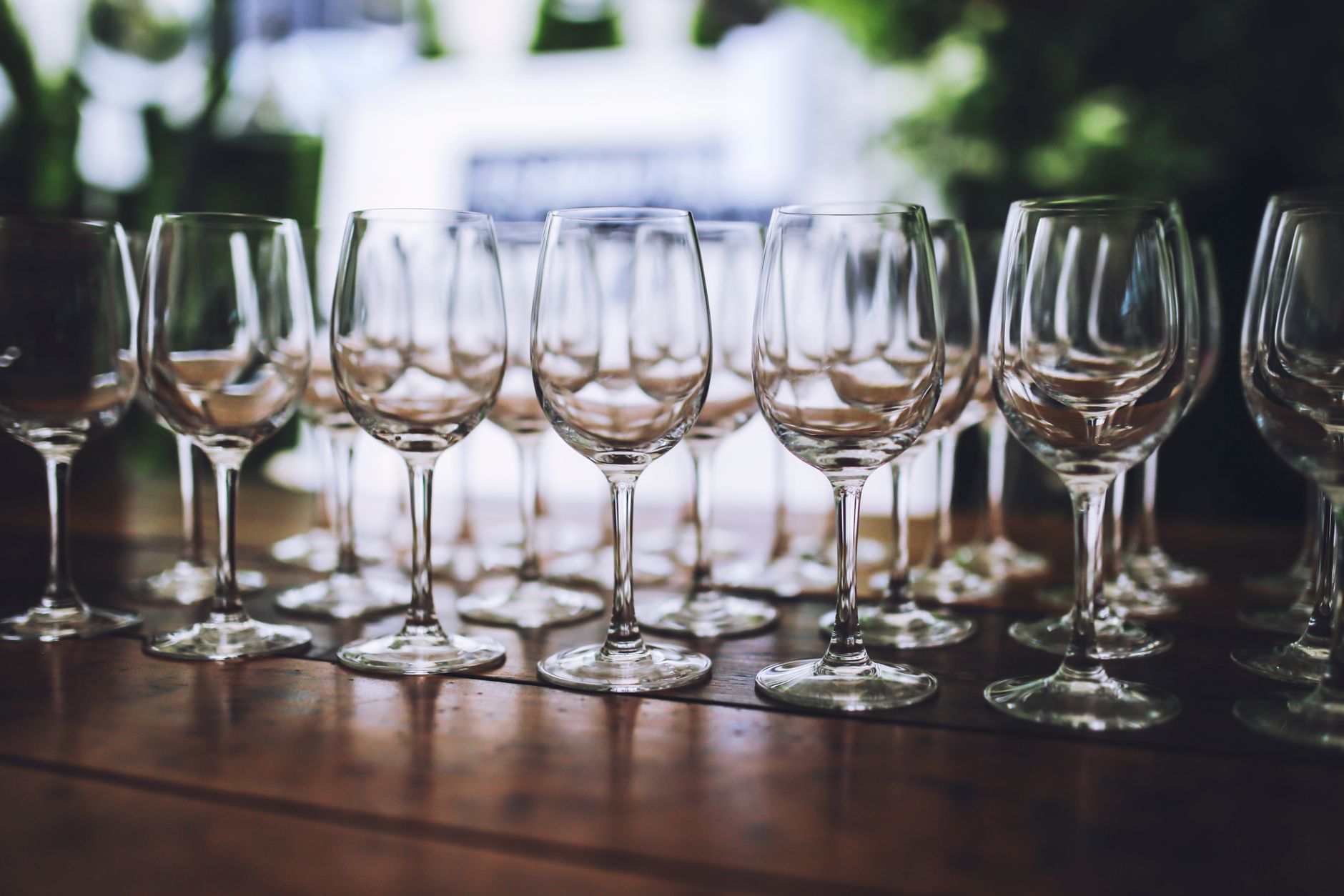
Stemware is beautiful and it is badly suited to an outdoor mountain reception. A wine glass has a high centre of gravity on a narrow base, and the surfaces available outdoors are cocktail tables on flagstone, railings, and the arm of an Adirondack chair. Add an afternoon gust coming down the valley and stemware doesn't tip — it launches.
For an outdoor fall reception, the better calls:
- Stemless wine glasses. Same pour, same look in photos, dramatically harder to knock over.
- Rocks glasses. Heavy base, low profile, the most wind-stable vessel on the bar.
- Footed glasses. A short foot gives you a little elegance without the lever arm of a true stem.
Keep the delicate stemware for seated dinner on a linen-covered table under cover, where it earns its keep. And if you want a proper toast outdoors, consider toasting in a coupe rather than a flute — it's shorter, steadier, and photographs beautifully.
What a Fall Mountain Bar Actually Needs
The instinct is a dedicated vessel per cocktail. Resist it — every extra glass type multiplies crates, staging space and the odds of running out of the one type everyone wants. Four or five is plenty for a fall menu:
- Rocks glasses — your workhorse this season. Bourbon, whiskey on ice, hot-weather-be-damned old fashioneds, and the mulled cider and spiced drinks people actually want when it's 38 degrees. Plan for these to carry the largest share of pours at a fall wedding.
- One all-purpose highball or tumbler. Vodka sodas, gin and tonics, mixers, mocktails, water. This is what keeps the line moving.
- Wine glasses — one shape, not two. A single all-purpose glass handles red and white. Two shapes doubles the inventory and solves a problem your guests don't have.
- Flutes or coupes, counted off your toast plan. This count is driven entirely by the toast: one per adult guest if everyone is toasting with sparkling, far fewer if only the head table is. Flutes are often used once, for about fifteen minutes, so pour them onto trays ahead of the speeches rather than through the bar.
Nobody Is Washing Glasses at 10,000 Feet
This is the part that catches hosts off guard. At an outdoor mountain bar there is usually limited water and often none at all — no three-compartment sink, no dish pit, no hot water. Which means glasses cannot be washed mid-service. Your entire glassware throughput is decided before the first guest arrives, by how many clean glasses physically showed up.
Two things fix this, and neither costs anything:
Bussing on a schedule. Someone needs to sweep the perimeter — railings, cocktail tables, the ceremony chairs, the fire pit — roughly every 20 minutes. Abandoned glasses are not lost, they're just in the wrong place. Confirm with your caterer or venue who owns that sweep, because it is the difference between a stocked bar and a bare one.
A glass-return spot near the bar. One clearly marked table or tub within a few steps of the bar, so guests who want to switch drinks have somewhere obvious to put the old glass. Guests will use it if it exists and won't go looking if it doesn't.
Who Brings What — Settle This Early
Here's the simple version, so you're not accidentally placing a rental order you don't need. The host supplies the alcohol; we provide the bartenders, bar setup, mixers, ice, and glassware. Our bartenders are TIPS/ServSafe alcohol-service certified.
Which leaves you three things to nail down, and none of them involve counting crates:
- Your guest count, including how many are actually drinking — that's what sets the glassware math.
- Your toast plan — everyone, or just the head table? This single answer can change your glass count by a hundred.
- Your venue's glass rules, by area, in writing.
Bring those three answers to the conversation and the glassware stops being something you worry about. If you're planning a fall wedding in Summit County and want to walk through your bar setup — guest count, toast, and where your venue allows glass — tell us about your event through our quote form and we'll build the plan around your site. Every event is quoted individually, so it's a conversation, not a catalogue.
← All posts