
Altitude · August 21, 2026
If you're planning a wedding in Breckenridge, Frisco, Keystone, or anywhere else in Summit County, someone in your family has probably already asked you the question: does alcohol hit harder at altitude, and should we be worried about the wedding? It's a fair question, and the honest answer is more interesting than a simple yes. The chemistry of what alcohol does to your bloodstream doesn't change much at 9,000 feet. What changes is the body it's landing in — and at a mountain wedding, most of those bodies flew in from sea level about eighteen hours ago. Here's what's actually happening, and a bar plan that accounts for it without turning your reception into a wellness seminar.
What Your Guests' Bodies Are Doing at 9,000 Feet
Summit County sits between roughly 8,000 and 10,000 feet depending on where you're standing. Breckenridge town is around 9,600. Copper's village is close to 9,700. At those elevations, there's meaningfully less oxygen available in every breath. A visitor who reads 98 or 99 percent oxygen saturation at home in Dallas may read in the high 80s or low 90s their first day here. That's not an emergency, but it produces a familiar cluster of symptoms: headache, mild nausea, poor sleep, shortness of breath on stairs, and a general woolly-headed feeling.
Layer dehydration on top of that. Mountain air is extremely dry, often well under 30 percent relative humidity, and people lose water simply by breathing it. Newcomers also breathe faster and urinate more as their bodies adjust. Add an outdoor ceremony in June sun at 9,500 feet, where UV exposure is dramatically stronger than at sea level, and a guest can arrive at cocktail hour already down a liter of water before they've touched a drink.
Does Alcohol Hit Harder at Altitude, or Does It Just Feel That Way?
Here's the nuance worth understanding as a host. Research on this has generally found that elevation doesn't dramatically change how much alcohol ends up in the bloodstream from a given number of drinks. Two glasses of wine at 9,000 feet produce roughly the same blood alcohol content as two glasses of wine at sea level.
But blood alcohol content is not what your guests experience. They experience impairment — and impairment is the sum of alcohol plus mild hypoxia plus dehydration plus a 4 a.m. wake-up for a flight plus a skipped lunch. Those things stack. Someone who genuinely feels fine after two drinks at home can feel unmistakably drunk after two drinks here, and they'll be surprised by it, because they were using their sea-level math. The person who says "I only had a few" is usually telling the truth. That's precisely the problem.
The Highest-Risk Guest at Your Wedding
It's the one who landed at DIA at 11 a.m., drove I-70 straight to Breckenridge, checked in, and walked into your welcome party at 6 p.m. Zero acclimatization, a travel day's worth of dehydration, airplane food, and now a cocktail in hand.
Twenty-four to forty-eight hours changes a lot. The body begins adjusting almost immediately — breathing rate, red blood cell activity, fluid balance — and most people feel noticeably more like themselves by day two. Guests who arrive two days ahead of your wedding will handle the reception far better than the ones who arrive the day before, and the ones who spend a night in Denver first do better still. You can't control travel plans, but you can build a bar that assumes at least a third of the room is running on day-one lungs.
The First-Hour Bar Plan That Actually Works
Most over-service at mountain weddings happens in a narrow window: the first sixty to ninety minutes after the ceremony, when guests are thirsty, food hasn't landed yet, and everyone's celebrating at once. Fix that hour and you've fixed most of the night.
- Put water at the bar, not across the lawn. A water station twenty feet away is a station people skip. We pour water directly at the bar and hand it over alongside the cocktail, unprompted. Plan on at least a liter of water per guest across the reception, plus ice.
- Make the first-hour signature drink a low-ABV one. An Aperol or St-Germain spritz built on sparkling wine, or a paloma with a lighter tequila pour and plenty of grapefruit, gives people something festive that isn't a double. A spritz lands somewhere near the strength of a glass of wine. A margarita on the rocks is closer to three.
- Open the bar with food, not before it. Passed appetizers should hit the floor at the same moment the bar opens, or slightly before. If your caterer needs ten minutes, we'll pour water, mocktails, and beer during that gap.
- Consider a pre-ceremony water and lemonade table instead of a pre-ceremony bar. Guests sitting in direct sun at 9,500 feet for a thirty-minute ceremony are much happier hydrated than buzzed.
Bar Design Choices That Do the Work For You
Batching helps enormously. A pre-batched cocktail is consistent — every guest gets the same measured pour, rather than a heavy-handed one at 6 p.m. and a heavier one at 9. It also moves the line faster, which reduces the "grab two while I'm up here" behavior that quietly doubles consumption.
Lead beer- and wine-forward. Stock the first hour so that the easiest, most visible options are lower-proof, and let the spirits program come into its own after dinner. Guests follow the path of least resistance, so make the path a good one.
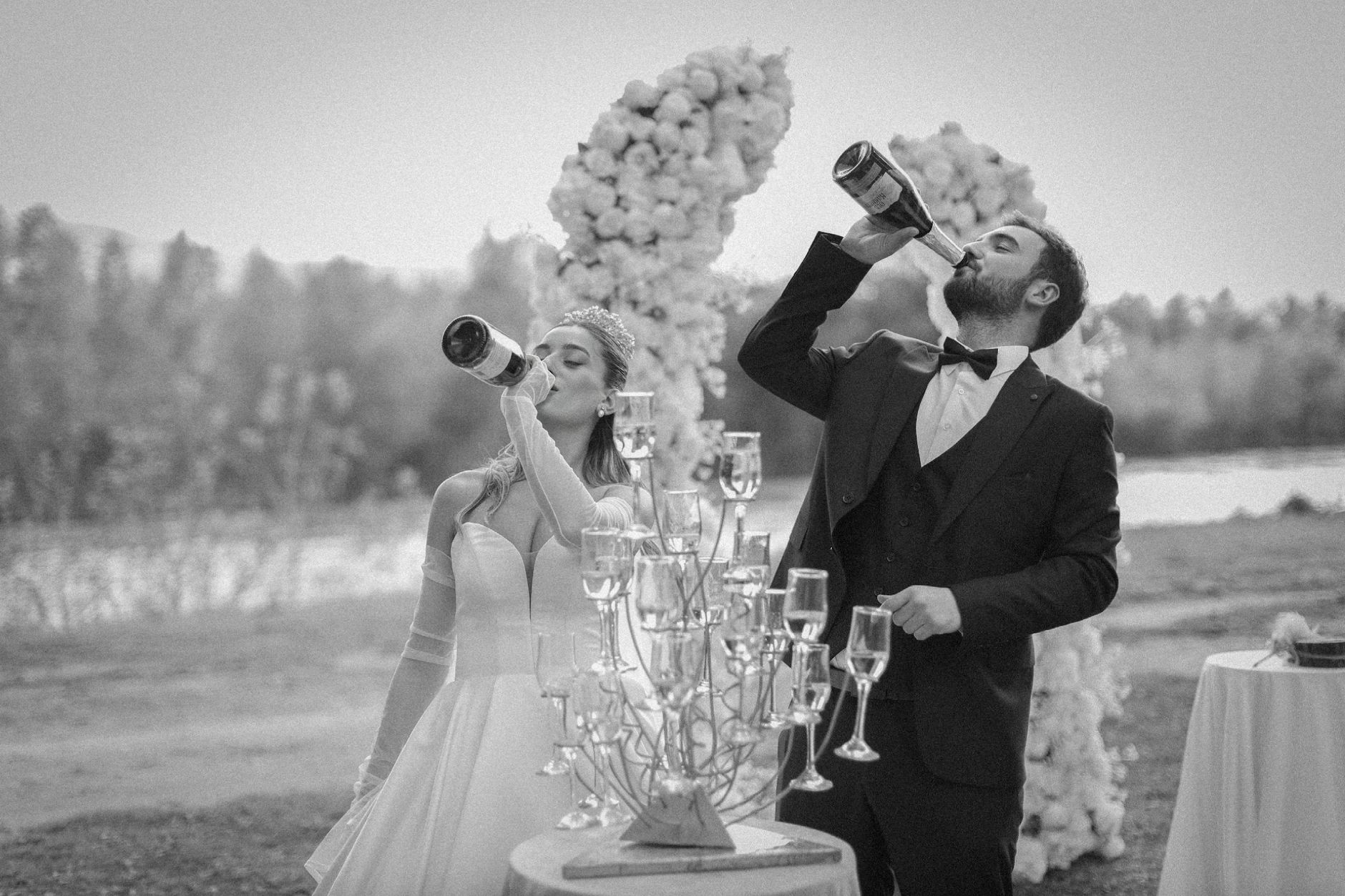
And be thoughtful about the champagne toast. A toast poured onto an empty stomach at 9,000 feet, after ninety minutes of cocktail hour and photos, is where the evening tends to tip. Schedule toasts after the first course has been served and eaten, not before. It costs you nothing and changes the trajectory of the reception.
How a Professional Cut-Off Looks at a Wedding
Our bartenders are TIPS/ServSafe alcohol-service certified, and at altitude we watch earlier and closer than we would at a sea-level event. The tells arrive sooner here: flushed face, repeating a story, slow speech, unsteadiness on uneven ground, a guest who's been in the sun all afternoon and hasn't eaten.
A good cut-off is almost invisible. It usually starts as hospitality, not refusal — a tall glass of ice water handed over warmly, a suggestion to try the zero-proof version of the signature drink, a plate of food found and delivered, a lighter pour, a longer conversation at the bar. If a firmer line is needed, we take it quietly, one-on-one, away from the crowd, and we loop in your planner or a designated point person rather than the two of you. Nobody should be pulling the couple off the dance floor to manage an uncle. That's our job.
What to Tell Guests Before They Arrive
A single line on your wedding website or in the welcome bag does real work. Something like:
"We're getting married at 9,600 feet, and the altitude is no joke. Drink twice the water you think you need, take it easy the first day, and know that one drink up here can feel like two. Sunscreen and a water bottle are in your bag — please use both."
For the wedding party, be more direct. They're the ones outside longest, in the sun for photos, often starting with mimosas at 9 a.m. and going all day. Ask them to eat a real breakfast, keep a water bottle in the getting-ready room, and treat the morning champagne as one drink rather than an open tap. If you can, ask them to arrive two days early. It's the single best thing they can do for your ceremony photos and your speeches.
We'll Build the Bar Around Your Timeline
Altitude planning isn't about serving less. It's about serving smarter — right drink, right hour, water in every hand, food on the floor when the bar opens. You supply the alcohol; we bring the bartenders, bar setup, mixers, ice, garnish, and glassware, and we'll help you build a menu and a pour schedule that fits your venue, your headcount, and your guest list's travel plans.
If you're working through your Summit County wedding timeline and want a second set of eyes on the bar plan, tell us about your day through the quote form. We'd love to hear what you're planning.
← All posts