
Cocktails · October 1, 2026
If you are planning hot cocktails for a fall mountain wedding in Summit County, there is one thing worth knowing before you buy a single cinnamon stick: water does not boil at 212°F up here. Around Dillon and Silverthorne, at roughly 9,000 feet, it boils closer to 195°F. In Breckenridge it's near 193°F, and up at Copper it's a touch lower still. That one fact is why a hot toddy that would have been lovely at an October wedding in Denver arrives merely warm at a Keystone reception. Of all the things that behave differently at elevation, this is the one that is purely an altitude problem — and it's fixable.Why Hot Drinks Underperform at 9,000 Feet
Two things are working against a hot drink at a mountain venue, and neither one is solved by turning up the heat.
The first is the ceiling. Your hot base cannot get hotter than boiling, and boiling up here is about 20 degrees cooler than it is at sea level. So every hot drink starts its life roughly 20 degrees behind.
The second is the exit. A 40° evening with dry wind moving across an open mug pulls heat out fast, and so does a room-temperature ceramic mug — the vessel takes its cut of the warmth before the guest ever gets a sip. Add the walk from the bar to a fire pit or a table on the deck, and a drink that left at 190° is no longer a hot drink by the time it's tasted.
That's the whole problem: a lower starting point and a faster fall. The fix is to stop losing degrees, not to chase degrees you can't get.
Pre-Warm the Vessel, Then Keep the Heat In
The single highest-return habit at a mountain hot-drink station is pre-warming. Mugs sit filled with hot water, get dumped the moment an order lands, and are built into warm. It costs a few seconds and it's the difference between a drink that reads hot and one that reads like tea someone forgot about.
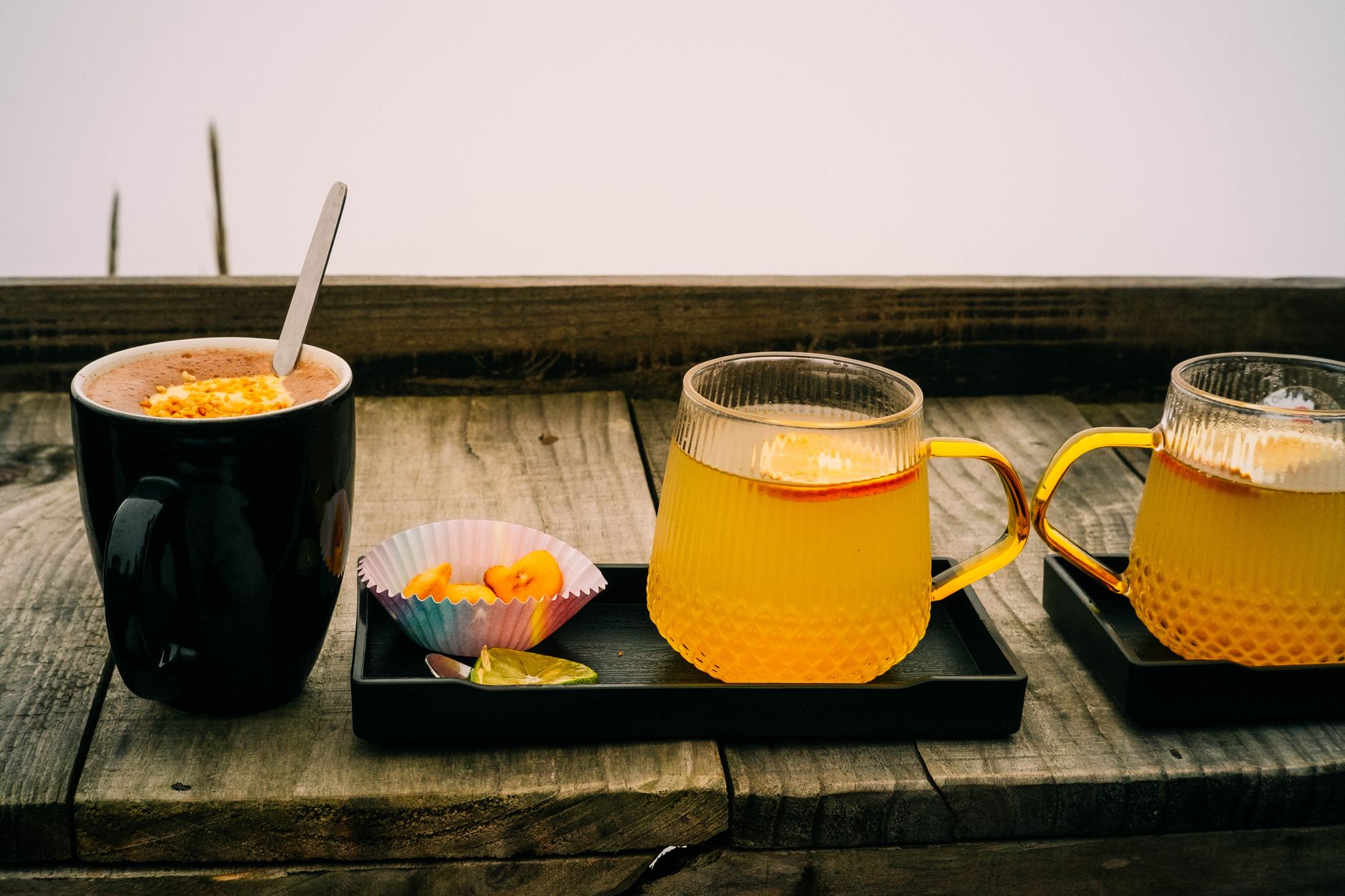
Vessel choice matters just as much. An open, thin-walled glass mug is a radiator. Something insulated — double-walled, or a hot cup with a sleeve — holds a drink in the pleasant range long enough for a guest to actually finish it outside. Glassware is on our side of the ledger, so this is a conversation we'll have with you rather than a shopping problem you have to solve: tell us the hot drinks are happening and where guests will be standing, and we'll bring vessels that suit 40° air.
One more practical note: the target serving temperature isn't boiling anyway. A drink handed over somewhere in the 150s is comfortable to sip immediately. Holding your base in the 170s and serving into a pre-warmed mug lands there naturally.
What to Buy for Hot Cocktails for a Fall Mountain Wedding
A three-drink hot menu covers almost every fall reception: a toddy, a spiked cider, and a mulled wine. Here is roughly what that looks like for 100 guests, assuming the hot menu runs through the back half of the night rather than all evening.
The alcohol — always the host's purchase:
- Bourbon or rye for toddies: two 1.75L handles, which covers 75 to 80 drinks at a 1.5 oz pour. Reach for something at 90 to 100 proof — an 80-proof whiskey gets buried under honey and lemon.
- Dark rum or apple brandy for cider: one to two handles. Apple brandy is the more interesting choice; dark rum is the safer crowd-pleaser.
- Dry red for mulled wine: twelve 750ml bottles yields about 60 five-ounce mugs. Pick inexpensive, low-tannin, unoaked — Grenache, Merlot, a basic Côtes du Rhône. Heat makes an oaky, tannic Cabernet taste bitter and hollow.
The rest of the inventory — cider, spices, citrus, sweeteners, ice, and garnish — generally sits with us, since mixers, ice, and garnish come with the bar. It's still worth seeing the real quantities so nothing about the scale surprises you:
- 5 gallons of apple cider (a gallon is about 21 six-ounce servings)
- 24 oz of honey, or a quart of maple syrup, cut 1:1 with hot water into a pourable syrup
- 3 dozen lemons, 8 oranges
- About 8 oz of cinnamon sticks, 2 oz of whole cloves, 1 oz of star anise, and half a dozen whole nutmegs for grating over the top
Fresh-grated nutmeg over a cider is the garnish guests comment on all night. It costs almost nothing.
How to Batch Without Boiling Off the Bourbon
Here's where altitude bites a second time. Alcohol boils at about 173°F at sea level, and like water, it boils lower as you climb. Up here it's down in the mid-160s — which means a spiked pot held at 175° all evening is actively evaporating the thing you paid for. By hour three you have a lovely, expensive cup of warm spiced juice.
So we batch in two parts:
- Build the spiced base first. Cider with cinnamon, cloves, star anise, and orange, steeped 30 to 45 minutes, then strained. For mulled wine, wine plus a little cider and the same spice bill, held warm and never allowed to simmer.
- Add the spirit at the end, or per drink. A measured pour into the mug at service keeps every drink at the same strength, keeps your bottles accounted for, and keeps the alcohol in the glass instead of in the air.
The Heat Source Is the Real Constraint
At most Summit County venues, this is the question that actually decides whether a hot menu is possible. A bar set up on a lawn, a deck, or a tent pad has no stove and often no kitchen access, so the base has to be heated somewhere and held somewhere.
Insulated beverage dispensers will hold a hot base for hours with no power at all, which makes them the dependable backbone. Electric urns are better if there's a circuit to spare — but "a circuit to spare" is exactly the thing that's scarce at an outdoor mountain bar, where lighting, a blender, and a cooler are already competing. If you're already working through power and water with your venue or planner, fold the hot drinks into that same conversation rather than treating it as a separate detail. It is the same decision.
When Guests Actually Want a Hot Drink
Hot drinks do not sell during cocktail hour. At 4 p.m. in September, with sun on the aspens, people want something cold. Demand arrives in two waves: right after an outdoor ceremony, when guests have been sitting still in the shade, and then again in the last hour or two, once the temperature drops and dancing has thinned out.
Plan accordingly. Hold the hot menu for the back half, open it for a post-ceremony window if the ceremony is outside, and keep one cold signature running the entire night. Guests who want a toddy at 9 p.m. will not have wanted one at 5.
Keep the Hot List Short — and Keep One With No Spirit
Hot drinks slow a bar line more than anything else on a menu. A cold pour takes seconds; a hot build means dumping a pre-warmed mug, ladling, measuring a spirit, and garnishing. Three builds is plenty. Five turns into a bottleneck exactly when the line is longest, and a long hot list is usually how a bar falls behind.
Keep one of those builds spirit-free: the spiced cider, straight, in the same mug with the same nutmeg on top. It's the drink that serves the designated drivers heading down to Frisco, the guests who are done drinking, and anyone feeling the elevation — and because it looks exactly like everyone else's, nobody has to explain themselves at the bar.
Our bartenders are TIPS/ServSafe alcohol-service certified, and the arrangement is simple: you supply the alcohol, and we provide the bartenders, bar setup, mixers, ice, garnish, and glassware. If you're weighing a hot menu for a fall date in Breckenridge, Keystone, Copper, or anywhere else in the county, tell us where the bar is going and whether there's power near it — that's usually all it takes to know what's workable. You can send us the details through the quote form whenever you're ready.
]]> ← All posts